Sunday, December 31, 2006

East Tennessee, in Many Pictures

Sunset on the 28th at Max Patch, NC. The biggest bald in the Appalachians.


Tractor Trailor awash in the TVA reservoir? Nuclear waste storage?

Me and two TVA goddesses.
Aurora, Momo and Mr. Man, reunited after a close call the week before Christmas with a motor vehicle for Ms. Momo.

A Hungarian Christmas feast.

(Hungarian by blood and at heart)


These are a few of my favorite things... dogs & beer.

Mill Street and Trivial Pursuit on the 27th

From back left around to back right: Will, Matt, Christina, Jenny, Aldo, Emily, and myself.

Sunday, December 24, 2006

If you're not aware, the reason you have had no fun stories from Brazil in the last 1.5 weeks or so is because I am in the states. Fun and wonderful things happen in the states, too. But there are people to see and things to do....'tis the holiday season! I hope this hiatus will not discourage your renewed interest, my loyal readers, when I am, once again, not able to participate directly in your reality. Damn, it sure is good to see some of you.

Happy Hanukkah/Christmas/time-with-your-family/holiday break/vacation....

Much love.

Monday, December 11, 2006

It's OK to be different.

I’m fairly certain that Brazilians are some of the friendliest and most open people I have yet to live among.

Several things about my day today (Sunday) inspired this posting.

1) While standing at the bus stop at 7:30AM, it starts to rain. Two other people are standing at the bus stop: an older man, and a teenage girl in a dress…perhaps on her way to church. As it begins to drizzle, the older man puts up his umbrella—he watches me put up my hood on my rain shell, and glances to the girl, who has long, dark hair…and no umbrella. Without a second thought, he moves towards her and covers her with his umbrella—they engage each other in conversation as if this were the most natural thing in the world until the bus arrives.

2) I arrive at the enormous Sunday handicraft market downtown feeling a little hungover and not so excited about the sea of people I am about to dive into. After passing stall upon stall of similar arrays of jewelry, I finally stop to start making Christmas purchases at one that struck my fancy, tired of stepping on people and sweating, en masse. I’m standing there, deliberating, and this woman comes up to me and says, in Portuguese, “Excuse me, but where are you from?” (Yes, I am still really white and I still have blue eyes. Occasionally I sport sunglasses and this helps a little and people don’t notice as much). I tell her I’m from the states, and she switches to English. “Oh good…because I’m going for an exchange to England in a couple of weeks, and I’m trying to pick out gifts for my host family…..” “All of this jewelry seems so normal and boring to me, but I know that you guys like it…” We both laugh. Having been in a similar position at points in my life, I try to remind her that the point (at least in my mind) is not so much whether they actually like or wear the gift—but more the fact that she comes bearing gifts is an expression of her gratitude to them…it’s symbolic.

She airs some of her apprehension to me about her study grant (something about social elements of governance in Britain) and about living abroad—we effectively block any sales from the unfortunate artisan’s stand as we converse in front of it for probably ten minutes. I’m sure it helped that I was holding about $40 worth of stuff that I was clearly intending on buying when I was finished gabbing. After we made our respective purchases, she left me with a kiss on the cheek and her cell phone number so we can go out and I can learn to dance forro when we are both back in February. Sweet.

3) This evening I’m at the Carrefour, our neighborhood grocery chain. I’m stocking up on bottled water—the idea of waking up thirsty in the middle of the night without bottled water makes me extremely anxious and has made me always keep at least a one-bottle reserve. Because, knowing myself, I am aware that if presented with the choice between drinking tap water in the middle of the night and going thirsty, I would readily gulp down a liter of tap water and all the potential impurities contained therein. So I’ve tried my best to be intentional about keeping bottle water reserves to continue the excellent intestinal health I have thus far enjoyed. Right. I’m buying water; young, attractive Brazilian man passes me in the beer isle and says “what’s up?” in English.

(By this point I’m wondering if it is readily apparent to everyone in the world that I am foreign today. I guess at this point I did have on my Carrharts, a tanktop and a pair of Chacos—not exactly average Brazilian woman grocery store-going attire.)

I wind up in line behind him, and he asks me in good English where I am from. I tell him I’m from the states, and he tells me that he studied and worked in San Francisco (slightly more understandable—he thinks I’m a California hippie!). He asks if I’m from California and welcomes me to Brazil with a grin that makes me blush deeply and makes the cashier giggle. I share an embarrassed laugh with her after he leaves…she asks me where I’m from (she’s been my cashier a few times in the past) and I ask her whether it’s that obvious that I’m not Brazilian. “You do have something different about you…” she says, and laughs. She asks me whether I like living here and whether it is better in Brazil or in the States. “They’re just different….” I say, and smile.

I did get spit on by a man out a bus window today with such excellent (or terrible) aim that I nearly shouted at him. But I suppose I am willing to put up with a lack of inhibition with respect to public urination and spitting for the related lack of inhibition that is manifested in Brazilian curiosity and friendliness.

Carmen's Birthday.

On Saturday night, we threw Carmen (the Guatemalteca) a surprise birthday party. She is the tiny one in red next to me in the first picture.

The blur is due to someone's wet beer-glass-condensation fingerprint (probably mine) on my camera lens.

Below: The foreign women. Carmen is happy about her surprise party.


I didn't know what to buy Carmen for her birthday, and as you can see, she has three bottles of red wine and three bags from "El Boticario," the Brazilian equivalent of Bath and Body Works. As an alternative, I did the flower arrangement. What kind of woman doesn't like flowers?


My kind of party involves people that sit around and sing. YES. Unfortunately, the songs that everyone sits around and sings in Brazil are not the same ones we do at similar parties in the states. Fortunately for me, someone handed me a tambourine. So I could at least feel like I was contributing something......

Friday, December 01, 2006

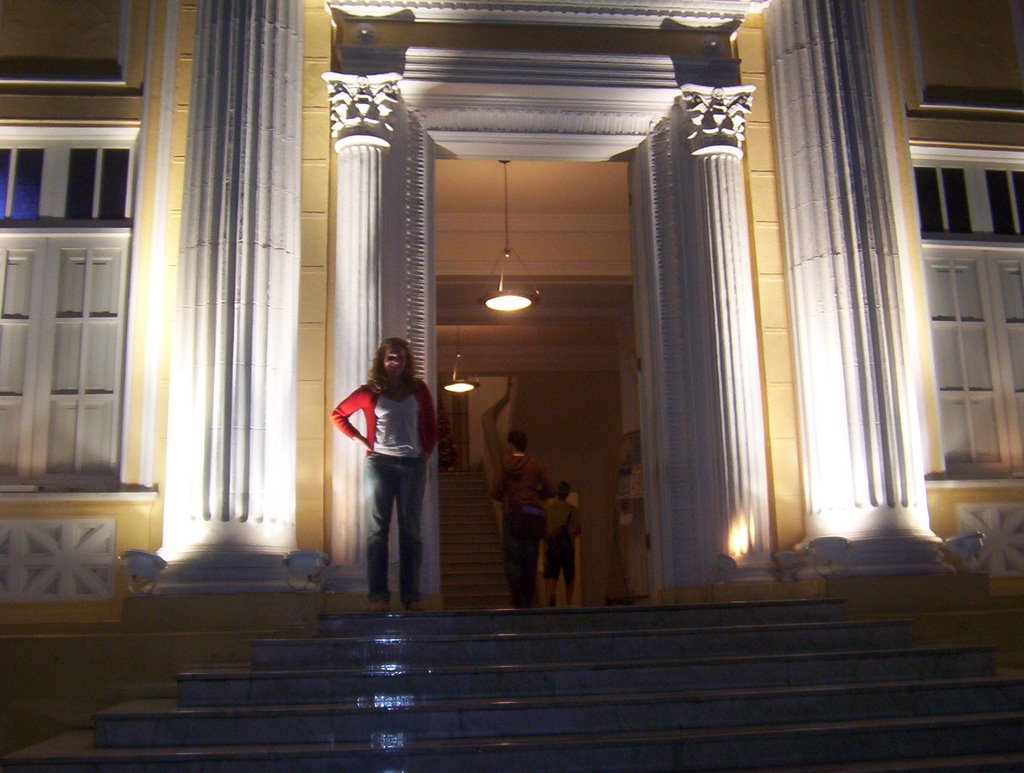
The lighted Conservatory at night.

Pictures below taken following a fabulous piano duo that made me want to play duets with my Dad, my Mom, my Aunt Anne, my Uncle Glen, or Margaret Watkins.

And preceding a late bus ride in the wrong direction, a bus ride back into town, a really excellent caipirinha, and a crepe.

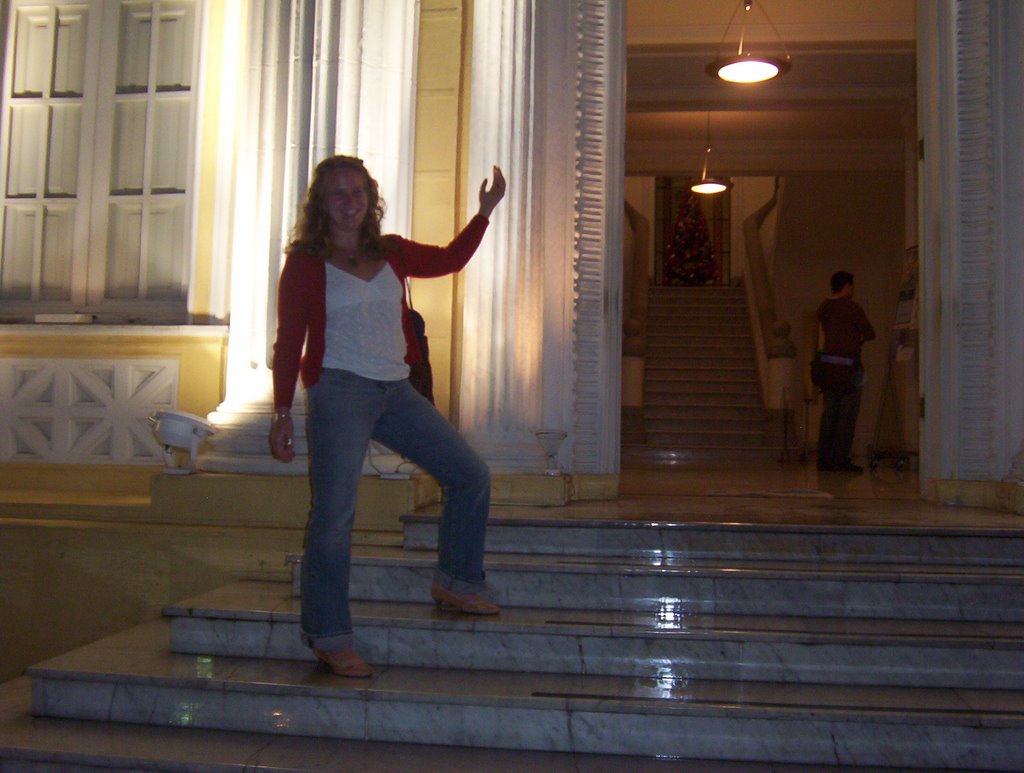
For those of you who asked whether I would give the infamous heels another chance at being integrated into my wardrobe, I managed to wear them for an evening without grimacing. See below.


Also, yesterday in the lake, they had a bulldozer clearing out mats of plant material on some sort of a floating barge thing. It was pretty cool and ingenious--shame that when the eutrophying plant material is removed, you just have to look at all the trash that was being hidden...the whole event even attracted some mango-eating spectators on their way home from work.

Monday, November 27, 2006

WHRC work in Brazil in the news.

Boston Globe article featuring Dan Nepstad, Frank Merry, and others talking about the fire problem in Brazil.

How many nationalities does it take to successfully celebrate a birthday?

Answer: 6. Two Germans, Three Brazilians, an Austrian, a Guatemalteca, an American, and the Colombian Birthday Girl.

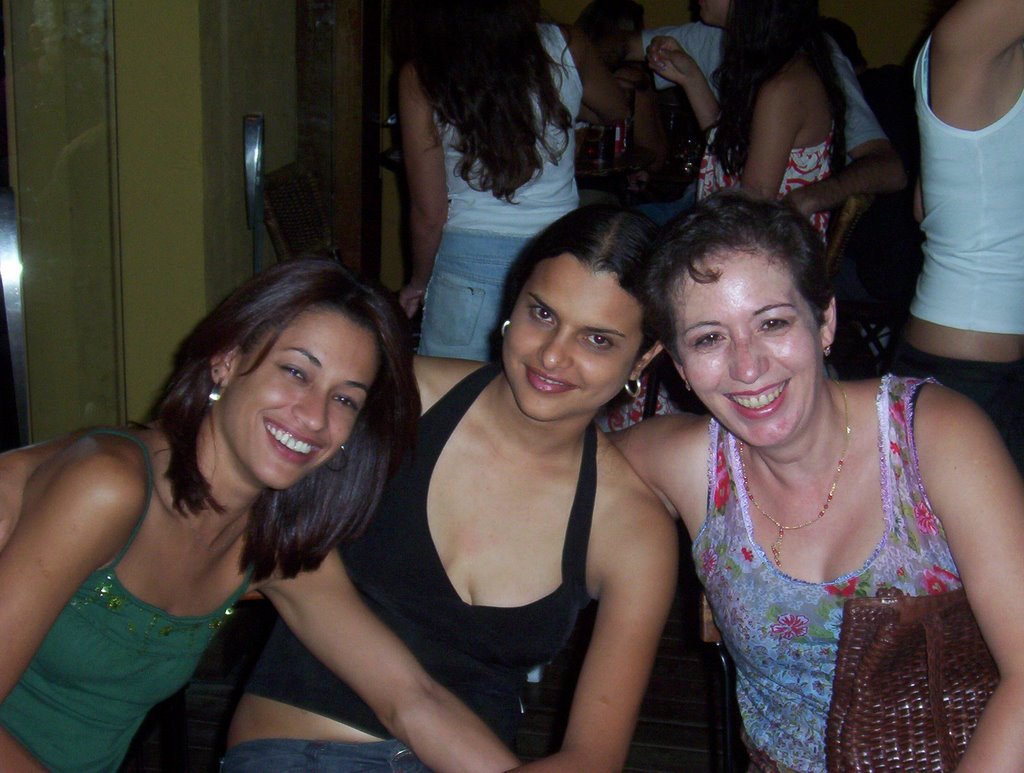
From left to right: Graça, Suzie, Ehidee

On Saturday evening we celebrated Ehidee’s birthday in a diverse array of Portuguese accents over some Birthday beers, and some traditional Brazilian guitar music which then transitioned into eighties covers when they ran out of Brazilian favorites. The group was quite an interesting mix: The Brazilian-born son-of-two-Germans spent most of the evening trying to elicit some sort of reaction from Carmen, the Guatemalteca. In addition to taking advantage of every opportunity to have his picture taken with the two of us (see below).

The Austrian owner of a Brazilian microbrewery was quite happy-go-lucky, and I learned much about the .5% of the Brazilian beer market which is comprised of microbreweries. He confirmed my assessment of the fact that there are, in practicality, no imported beers in Brazil. That when I am drinking Stella Artois or Heineken, they have been bottled in the Southern Hemisphere.

The younger German spent some time complaining about his headache, but seemed to be enjoying texting enthusiastically (rather more than conversing with the diverse array of female company). At one point Ehidee turned to me and said: “¡Me encantan los hombres que prefieran jugar con sus celulares que conversar con la gente!” (“Don’t you just love men that prefer playing with their cellphones to actually talking to people?”) I promptly burst into laughter and responded “¡Como no!”(“How could you not?”) He did not look up.

Ehidee had already informed me about Suzie’s same-sex preferences, but Suzie also decided to inform me herself. The conversation went as follows (a rough translation from Portuguese).

Suzie: “I want to tell you something…..I’m a lesbian.”

Me: “I know. No big deal—she (Ehidee) told me.”

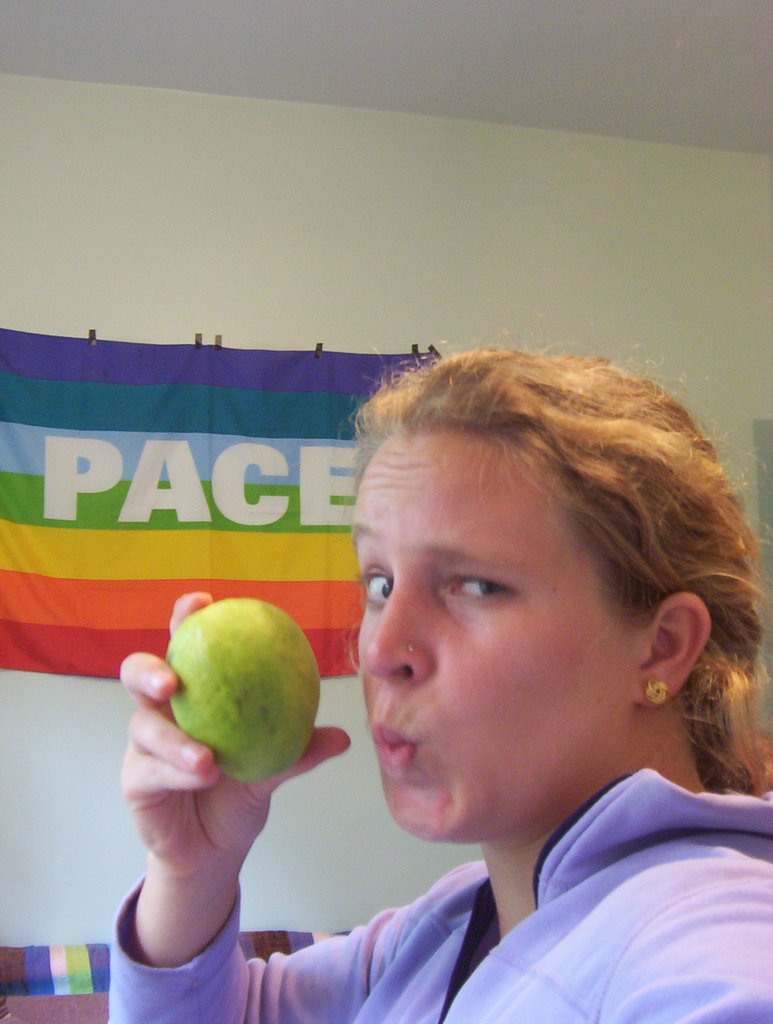
Suzie: “At first when I saw the rainbow flag in your room, I thought….”

Me: (laughter)

Suzie: “But then I figured out it was just a peace flag.”

(laughter)

Suzie: “It’s ok: I’ve already been with an American.”

Me: “And?”

Suzie: “It was boring. The only thing she knew how to say in Portuguese was “você e muito bela—“it got old.”

Lessons of the evening:

Don’t hand your camera to a drunk German/Brazilian unless you are willing to relinquish it for a while.

If you’re going to try to seduce someone of either sex, you’d best learn how to tell them something in their native tongue other than that they are attractive.


Friday, November 24, 2006

thanksgiving

There is nothing quite like getting sick on Thanksgiving to:

a) make me feel extremely thankful for being continuously blessed with good health
b) provide me with plenty of time to lay around (nonmoving) and think about the many friends, family and opportunities with whom/which I am richly blessed
c) read a favorite book
d) pretend my mother is there telling me to gargle with salt water (yes, mom, I did.)

Thursday, November 16, 2006

Fruit.

Avocados here are delightful, and twice the size of the ones in the states:

Do not be fooled. The fruit below may appear to be pear-like, but it is a Goiaba, or Guava. It is one of the most delightful fruits ever, at least in my humble opinion. There are red and white varieties in the grocery store here, and they are both fantastic. The red variety provides for a lovely aesthetic experience while munching, but the white is tastier, I think. I especially like the crunchy seeds surrounded by sweet inner core of goodnes, with a tart, granny-smith-like exterior 'mantle'. If you do not already feel good about Guavas, note that they are high in fiber and in Vitamin C!


The tomatoes here, however, do not hold a candle to the tomatoes we get in VA. Even the less-than-ripe, character-less ones you get in the Kroger or the Food Lion. Sorry, Brazil.

Tuesday, November 14, 2006

A troubled post about the fate of Hydrochaeris hydrochaeris in Belo Horizonte

I have noticed during the past several weeks that the Lagoa da Pampulha is not looking so hot. My suspicion is that this is a direct result of recent rains that carry all kinds of wastewater and solid waste into the lake. It smells terrible and looks even worse--I don't like to bother carrying a camera around on most walks in the city, and the pictures would make you unhappy.

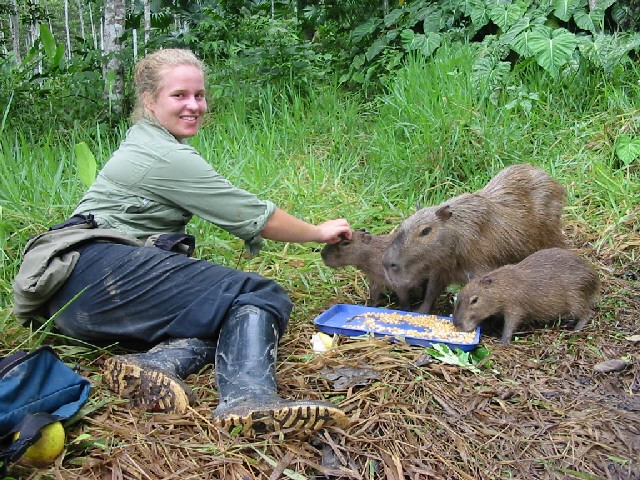
On Sunday I went out for a walk. On the way back towards my house, I notice a large brown animal on the trash-strewn shore of the lake. I knew immediately what it was, given my near transformation into one during my several months researching and caring for them in Ecuador: a capybara. I stopped and took out my headphones. I stood perfectly still for several minutes, staring intently at the body to see if there was any movement from breathing--but there wasn't. I must have looked upset; a man stopped next to me and said "it's a capybara!" "Yes," I said, "it is a capybara." "Is it dead or alive?" He asked. "Dead, I think," I said. He was convinced that it must have escaped from the nearby zoo. "they don't live here!" He said. I started to try and tell him that they might, actually, live in the lake...and then decided it wasn't worth it. He would have no reason to believe my word on that one, and probably would not have believed me if I told him I had spent a whole semester researching the animal.

The very sad part of this is, that the capybara was probably, up until it's demise, living happily in the Lagoa da Pampulha until it ate something toxic or suffocated in the incredible stinking matt of algae covering the grassland on the edge of the lake. The body was still there yesterday and I am too angry and sad to write anything else about it. Here is a happy picture of some very sweet domesticated capybara, for old times' sake:

Monday, November 13, 2006

“That’s not a tree; it’s a carbon stock!”

(This one is for my Dad—who I fear, if he didn’t know me as well as he does, might be convinced that I really believe that everything in life is economically quantifiable.)

*******

It is 2015: a sunny October Saturday in an urban neighborhood of Richmond, VA (insert other, more relatable city). An attractive family with the requisite 2.1 children is out for a stroll, and is walking towards the community garden and natural preserve to pick a few apples and get the dog (a frisky beagle) out of the house. In the last year they have moved from a suburb that was a 45 minute commute to work for each, to an area closer to the downtown as a result of several new greening projects (aided, in Richmond, by a well-trained force of strikingly enthusiastic Virginia Tech Urban Forestry students).

They are meandering down a path in a picturesque wooded area. They all yell for the dog as he bounds off after a rabbit—the children play tag and roll in the leaves. The father summons the children (ages 8 and 10) over to talk to them about the stately, historic red oak that borders the path (with a small plaque designed by a Virginia Tech student), saying: “Come here and let me tell you about this tree!” The boy, age 8, pipes up knowingly: “Dad, that’s not a tree! It’s a CARBON stock!” Confusion flickers across the father’s face as his mind takes him back to freshman biology lecture, most of which he realized then that he had slept through. He rumples his child’s hair and says: “Well, I guess you are right, son. It is a carbon stock.”

*******

Return to the present with me. This weekend I have been translating a document into English by a colleague here at the University for the Woods Hole people to take to the global conference on climate change taking place soon in Nairobi. This document summarizes recent research about predicted deforestation and loss of carbon from the Brazilian Amazon and argues for the instating of a carbon trading system for deforestation avoided by developing nations. I was struck by a sentence that said, more or less, that the Amazon should not simply be seen as the world’s largest carbon stock. That the valuation of carbon tied up in the forest is one way to preserve all the other various resources and the intangible value associated with the forest, for all posterity.

But indeed, what are our options for visualizing something as vast as a forest resource? Our new technologies and incredible amount of knowledge allow us to predict and quantify the movement of something so intangible as Carbon—something that escapes into the atmosphere when we set fire to it, gets tied up in trees, powers our vehicles, and somehow contributes to the warming of our planet over time.

I suppose, at a personal level, I question our ability to balance this view of quantification of the earth’s services while still retaining the wonder that we experience when we walk in the forest, and the rich historical tradition of peoples that have, for centuries, been dependent on the forest.

Ecologists and economists both think in green, at least with respect to forests. As an economist, the idea that I could go walk around in the forest if I wanted to is worth something to me. As is the idea that there are people still running around with bones in their noses and hunting still-present monkeys with poison blow darts. And what I would or have actually paid to do these things is probably the best measure that we have for what they are worth, in terms of their ‘use value’. But is that really all there is to it?

How do we keep humanity seeing green, feeling green and doing green? And I don’t mean merely appreciating the fact that the rainforest ties up carbon that would otherwise be contributing to global warming (and threatening the long-term viability of our race). Not just realizing, with a warm sense of satisfaction, that our annual contribution to the Nature Conservancy gives us a 10% discount if we should ever want to go fly fishing in Montana. Not just eating organic food to alleviate guilt, or to improve our lithe physiques. Not just walking in the woods because the subsequent ‘clearing of our head’ will allow us to reach a new height of productivity at work on Monday.

When I am able detach myself from economic valuation mode, if you will, I am able to think about my own experience and how it has led me to thinking in green (economic terms) in a belief that this will leave us with the prospect of being able to see green, feel green, and do green well into the future. I find that my wanting to learn to think in green is a direct result of my taking part in, for many years, the more tangible, perceptual and emotional greens (seeing, feeling, and doing).

As a child, I would climb the hill behind my house to watch the sunset from the top of a red cedar tree. I would wander the ridge, wondering what the enormous piles of stone were that were covered in leaves—I used to think they were Indian burials until someone wiser informed me that they were the stones that had been removed during the plowing of the fields, which I found a very practical explanation. I remember wondering what I was going to tell my parents after I wrapped our family canoe around a tree in the Middle River at flood stage with my friend Scott (who, despite this experience, was hired as an international kayaking instructor).

Insect and leaf collecting in Mary Ann Angleberger's Biology class. Riding my horse alone in fields full of cows. Hiking down the Grand Canyon with three generations of extended family. Getting lost in caves with my mom, dad and brother—and having to calmly convince my brother that we would, in fact, make it out alive. Weekends at the Juniata field station where I saw my first porcupine (they still fascinate me…), and where you wait on flocks of turkeys to cross the road. Jaunts in the jungle where I have taken, on faith, a flash of brilliant color as the only sign of a rare bird. Sleeping under the stars in Clover Hollow, outside of Blacksburg. Walks on gravel roads in Grottoes where I can almost reach out and hug the inviting, feminine curves of the Blue Ridge—as if she might, in fact, be my spiritual mother.

I could go on—but here is my simple point: there is a history and a future associated with every landscape. A history of natural evolution which is enough to inspire belief in God among cultures everywhere. A human history that shaped and was shaped by the landscape. A personal history—the history created as a result of the time that I took to interact with my landscape—to let it shape who I am.

I have chosen to embrace economic logic, to believe in the power of thinking in green. I have not, however, had to relinquish seeing, feeling, or doing green to embrace this economic paradigm. I will even argue that there is a mysterious element of synergy—that because I allow myself to explore the limits of economic paradigms through my own experience, I am forced to continually challenge myself to think critically and creatively about the ways in which we can think, in green, for the welfare of our own and for that of future generations.

The fact is, a hypothetical ability to visit a national park, memorization of statistics about global carbon, or how much I might be willing to pay (or have paid in actuality) to see an endangered species, are only peripherally related to what inspires me to see, feel, or do, in green. Only an actual visit—a visit to the classroom of the outdoors—will open me to being drenched by a thunderstorm or startled by a rattlesnake, to being moved to tears by a sunrise. And only this openness to change the ways in which I interact with the world through the lessons of my own experience has inspired—will inspire—these three things in me. And this, my friends, is a process that even the most creative of economists would find difficult to model or quantify.