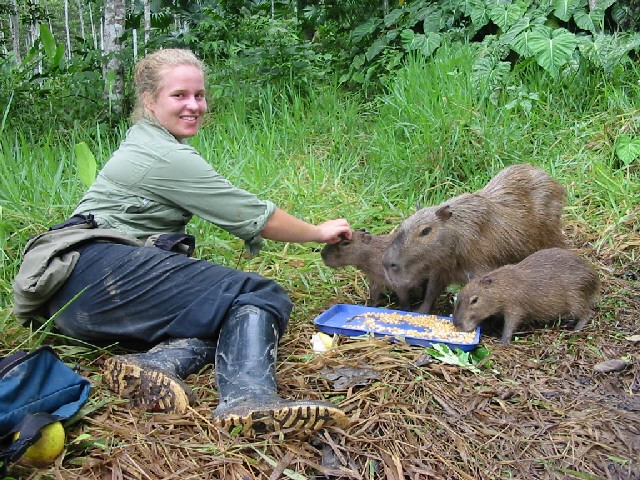
(This one is for my Dad—who I fear, if he didn’t know me as well as he does, might be convinced that I really believe that everything in life is economically quantifiable.)
*******
It is 2015: a sunny October Saturday in an urban neighborhood of Richmond, VA (insert other, more relatable city). An attractive family with the requisite 2.1 children is out for a stroll, and is walking towards the community garden and natural preserve to pick a few apples and get the dog (a frisky beagle) out of the house. In the last year they have moved from a suburb that was a 45 minute commute to work for each, to an area closer to the downtown as a result of several new greening projects (aided, in Richmond, by a well-trained force of strikingly enthusiastic Virginia Tech Urban Forestry students).
They are meandering down a path in a picturesque wooded area. They all yell for the dog as he bounds off after a rabbit—the children play tag and roll in the leaves. The father summons the children (ages 8 and 10) over to talk to them about the stately, historic red oak that borders the path (with a small plaque designed by a Virginia Tech student), saying: “Come here and let me tell you about this tree!” The boy, age 8, pipes up knowingly: “Dad, that’s not a tree! It’s a CARBON stock!” Confusion flickers across the father’s face as his mind takes him back to freshman biology lecture, most of which he realized then that he had slept through. He rumples his child’s hair and says: “Well, I guess you are right, son. It is a carbon stock.”
*******
Return to the present with me. This weekend I have been translating a document into English by a colleague here at the University for the Woods Hole people to take to the global conference on climate change taking place soon in Nairobi. This document summarizes recent research about predicted deforestation and loss of carbon from the Brazilian Amazon and argues for the instating of a carbon trading system for deforestation avoided by developing nations. I was struck by a sentence that said, more or less, that the Amazon should not simply be seen as the world’s largest carbon stock. That the valuation of carbon tied up in the forest is one way to preserve all the other various resources and the intangible value associated with the forest, for all posterity.
But indeed, what are our options for visualizing something as vast as a forest resource? Our new technologies and incredible amount of knowledge allow us to predict and quantify the movement of something so intangible as Carbon—something that escapes into the atmosphere when we set fire to it, gets tied up in trees, powers our vehicles, and somehow contributes to the warming of our planet over time.
I suppose, at a personal level, I question our ability to balance this view of quantification of the earth’s services while still retaining the wonder that we experience when we walk in the forest, and the rich historical tradition of peoples that have, for centuries, been dependent on the forest.
Ecologists and economists both think in green, at least with respect to forests. As an economist, the idea that I could go walk around in the forest if I wanted to is worth something to me. As is the idea that there are people still running around with bones in their noses and hunting still-present monkeys with poison blow darts. And what I would or have actually paid to do these things is probably the best measure that we have for what they are worth, in terms of their ‘use value’. But is that really all there is to it?
How do we keep humanity seeing green, feeling green and doing green? And I don’t mean merely appreciating the fact that the rainforest ties up carbon that would otherwise be contributing to global warming (and threatening the long-term viability of our race). Not just realizing, with a warm sense of satisfaction, that our annual contribution to the Nature Conservancy gives us a 10% discount if we should ever want to go fly fishing in Montana. Not just eating organic food to alleviate guilt, or to improve our lithe physiques. Not just walking in the woods because the subsequent ‘clearing of our head’ will allow us to reach a new height of productivity at work on Monday.
When I am able detach myself from economic valuation mode, if you will, I am able to think about my own experience and how it has led me to thinking in green (economic terms) in a belief that this will leave us with the prospect of being able to see green, feel green, and do green well into the future. I find that my wanting to learn to think in green is a direct result of my taking part in, for many years, the more tangible, perceptual and emotional greens (seeing, feeling, and doing).
As a child, I would climb the hill behind my house to watch the sunset from the top of a red cedar tree. I would wander the ridge, wondering what the enormous piles of stone were that were covered in leaves—I used to think they were Indian burials until someone wiser informed me that they were the stones that had been removed during the plowing of the fields, which I found a very practical explanation. I remember wondering what I was going to tell my parents after I wrapped our family canoe around a tree in the Middle River at flood stage with my friend Scott (who, despite this experience, was hired as an international kayaking instructor).
Insect and leaf collecting in Mary Ann Angleberger's Biology class. Riding my horse alone in fields full of cows. Hiking down the Grand Canyon with three generations of extended family. Getting lost in caves with my mom, dad and brother—and having to calmly convince my brother that we would, in fact, make it out alive. Weekends at the Juniata field station where I saw my first porcupine (they still fascinate me…), and where you wait on flocks of turkeys to cross the road. Jaunts in the jungle where I have taken, on faith, a flash of brilliant color as the only sign of a rare bird. Sleeping under the stars in Clover Hollow, outside of Blacksburg. Walks on gravel roads in Grottoes where I can almost reach out and hug the inviting, feminine curves of the Blue Ridge—as if she might, in fact, be my spiritual mother.
I could go on—but here is my simple point: there is a history and a future associated with every landscape. A history of natural evolution which is enough to inspire belief in God among cultures everywhere. A human history that shaped and was shaped by the landscape. A personal history—the history created as a result of the time that I took to interact with my landscape—to let it shape who I am.
I have chosen to embrace economic logic, to believe in the power of thinking in green. I have not, however, had to relinquish seeing, feeling, or doing green to embrace this economic paradigm. I will even argue that there is a mysterious element of synergy—that because I allow myself to explore the limits of economic paradigms through my own experience, I am forced to continually challenge myself to think critically and creatively about the ways in which we can think, in green, for the welfare of our own and for that of future generations.
The fact is, a hypothetical ability to visit a national park, memorization of statistics about global carbon, or how much I might be willing to pay (or have paid in actuality) to see an endangered species, are only peripherally related to what inspires me to see, feel, or do, in green. Only an actual visit—a visit to the classroom of the outdoors—will open me to being drenched by a thunderstorm or startled by a rattlesnake, to being moved to tears by a sunrise. And only this openness to change the ways in which I interact with the world through the lessons of my own experience has inspired—will inspire—these three things in me. And this, my friends, is a process that even the most creative of economists would find difficult to model or quantify.

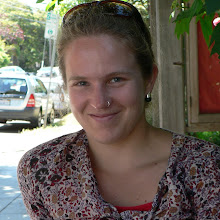


 Me and two TVA goddesses.
 Aurora, Momo and Mr. Man, reunited after a close call the week before Christmas with a motor vehicle for Ms. Momo.